
IIT Madras partners with Finnish Meteorological Institute to launch Advanced Research Centre
- 16th Feb 2026
-
Press Release
Indian Institute of Technology Madras (IIT Madras) is partnering with Finnish Meteorological Institute (FMI) to create a knowledge hub ‘VAYYU’ — the Virtual Research Centre on Aerosol–Meteorology Interactions, Himalayan Atmosphere-Cryosphere interactions, and Urban Air.
The new centre will focus on advanced simulations and state-of-the-art observations to better understand how aerosols influence regional hydro-climate, Himalayan snow and glacier melting, and Air Quality in Indian megacities and beyond.
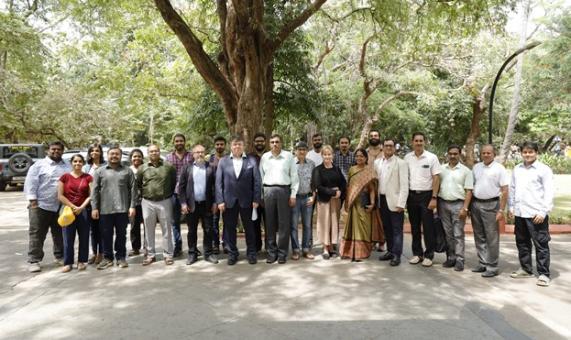
A MoU towards this collaboration was signed recently by Prof. Shanti Pawan, Dean (Research), Prof. Manu Santhanam, Dean (ICSR) and VAYYU research centre coordinator, Prof. Chandan Sarangi, Department of Civil Engineering, IIT Madras, along with FMI leadership, including Prof. Petteri Taalas, Prof. Hannele Korhonen and Dr. Rakesh K. Hooda.
Welcoming this collaboration, Prof. V. Kamakoti, Director, IIT Madras, said, “Climate change and monitoring is the most important area to be investigated in a global platform. It is very heartening to note that IIT Madras will partner with Finnish Meteorological Institute in this very important topic.”
Further, Prof. Petteri Taalas, Director General, Finnish Meteorological Institute, said, “I am pleased to strengthen our collaboration with IIT Madras through this MoU, building on three years of joint work on Himalayan aerosols to address challenges of importance to India and the wider world.”
The partnership will significantly enhance Indo-Finnish cooperation in climate science, urban sustainability and next-generation environmental research. It also strengthens IIT Madras’ global engagement in climate action and sustainability.
Moreover, Mr. Hemant H. Kotalwar, Ambassador of India to Finland, said, “The India-Finland collaboration through VAYYU marks a significant milestone in bilateral science diplomacy, bridging IIT Madras' modelling prowess with FMI's climate expertise to tackle aerosol-driven risks to our monsoons and urban health. This virtual centre will empower Indian researchers with cutting-edge tools for predictive hydro-meteorology and air quality management, strengthening our shared vision for sustainable development."
Mr. Kimmo Lahdevirta, Ambassador of Finland to India, said, “This partnership exemplifies Finland's commitment to collaborative climate science, leveraging FMI's world-class expertise in aerosol dynamics and weather prediction to address pressing challenges in South Asia. VAYYU will foster innovation in modelling aerosol impacts on monsoons and air quality, paving the way for joint policies that enhance regional resilience."
VAYYU builds on two major international research initiatives that already link IIT Madras and the Finnish Meteorological Institute (FMI).
One of these is the CryoSCOPE project—jointly funded by the European Union, SERI (Switzerland), and the Ministry of Earth Sciences, India—with a total investment of approximately E10 million. CryoSCOPE deploys state-of-the-art monitoring systems at a supersite in Kargil, Himalayas to investigate atmosphere–cryosphere-hydrosphere coupled processes, and quantify the role of aerosols in accelerating glacier melt and drought/flood conditions over Himalayan cryosphere.
Second, the Research Council of Finland–funded CO-ENHANCIN project has enabled the establishment of IIT Madras’s new urban observatory in Chennai, worth approximately ₹5 crore INR. Located at the IIT Madras satellite campus, the observatory uniquely represents a coastal tropical megacity environment. It is equipped with sophisticated aerosol and atmospheric chemistry analysers, lidar profilers, eddy-covariance flux towers, rain radar, and a dense network of total-sky imagers to investigate land–atmosphere boundary-layer processes and aerosol–cloud–rain interactions. This facility translates insights from CO-ENHANCIN into live, high-resolution data that support urban air-quality assessment, local weather prediction, and climate-resilience planning.
VAYYU will also bring together a wide consortium of leading national and international scientists, creating a collaborative platform where observational experts, modellers and engineers work closely. By combining IIT Madras’ strengths in atmospheric modelling, systems thinking and engineering-led solutions with FMI’s globally recognised expertise in climate and aerosol science, the centre aims to deliver actionable insights, robust climate risk assessments and policy-relevant tools to support sustainable development.
Elaborating on the benefits to India from VAYYU, research centre coordinator, Prof. Chandan Sarangi, Department of Civil Engineering, IIT Madras, said, “Currently, our understanding of pollution–climate coupling remains uncertain. This Centre aims to bring together complementary expertise and coordinated efforts to improve coupled climate–chemistry modelling over India, thereby improving estimates of aerosol–climate impacts and strengthening our understanding of meteorology–air quality interactions, particularly over Indian megacities.”
IIT Madras and the Finnish Meteorological Institute (FMI) have collaborated over the past four years through joint scientific field campaigns and structured exchange programmes. “Looking ahead, VAYYU will develop ambitious multilateral and bilateral joint research proposals aligned with India’s scientific and technological priorities in weather forecasting, air quality prediction and last-mile impact to meet the SDGs," said Rakesh K Hooda, Lead Collaborator of VAYYU research centre, Senior Principal Scientist and Indo-Finnish Research Coordinator, FMI. He is also a VAIBHAV Fellowship awardee at IIT Madras from Department of Science and Technology, India.
The partnership emphasises human capital development via student and faculty exchanges, winter schools on climate and cryosphere modelling, and summer research internships. Knowledge transfer is further supported through specialised workshops on advanced atmospheric instrumentation, machine-learning-based aerosol parameterisations, and access to FMI’s supercomputing resources.