

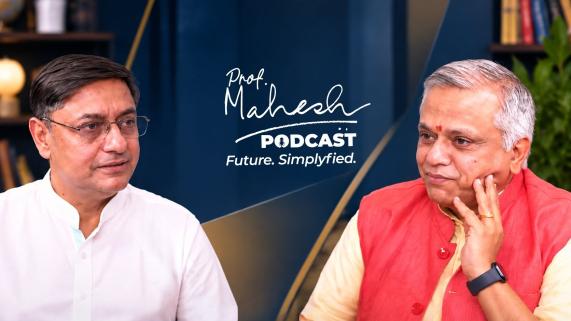
IIT Madras faculty podcast with Mr. Sanjeev Sanyal explores careers, uncertainty and adapting to an AI-driven future
- 24th Sep 2026
-
Press Release
CHENNAI: Indian Institute of Technology Madras (IIT Madras) Prof. Mahesh Panchagnula hosted Mr. Sanjeev Sanyal, Member, Economic Advisory Council to the Prime Minister, in his podcast series that aims to educate students and parents to make informed decisions about careers in engineering and science.
The latest episode of ‘The Prof. Mahesh Podcast’, aired today (24th Sept 2026), aims to create awareness among students on navigating career decisions in an increasingly unpredictable world shaped by technological disruption, changing economic opportunities and AI.
Mr. Sanjeev Sanyal pointed to the growth of start-ups and experimentation, including at IIT Madras, as evidence of a broader willingness to take risks. He also emphasised the role of parents in this process, urging them to give young people room to develop their own paths rather than placing the burden of fulfilling inherited aspirations on them.
LINK TO THE EPISODE - https://www.youtube.com/watch?v=hDzsRkCA0pQ
PODCAST PLATFORMS:
YouTube: https://www.youtube.com/@ProfMaheshPodcast
Instagram: instagram.com/profmaheshpodcast
LinkedIn: linkedin.com/in/mahesh-panchagnula-6a89118
YouTube Shorts and clips: youtube.com/channel/UC8kFMpxlYwnggC8r3DqN1Wg
Prof. Mahesh Panchagnula, Alumni Community Chair Professor, Department of Applied Mechanics and Biomedical Engineering, anchors this podcast, which features in-depth conversations with experts. The latest episode challenges the widely held idea that young people must identify the “right” career path early in life, arguing instead that careers evolve through choices, chance, experimentation and circumstances that cannot always be predicted.
The Prof. Mahesh Podcast, supported by the Center for Outreach and Digital Education (CODE), IIT Madras, aims to address the information gap faced by students and parents when making educational and career decisions. Each episode typically features an extended conversation with experts covering career opportunities, how professions have evolved, emerging trends, and opportunities for innovation and entrepreneurship.
The podcast also seeks to create a space where students and parents can ask questions and engage with experts through social media. Episodes and clips are being made available through major digital platforms, with summaries intended to support access in English, Hindi, Tamil and Telugu.
Speaking about the pressure students face while making early career decisions, Mr. Sanjeev Sanyal said that the search for a predetermined “safe career” or a perfect initial choice is based on an overly mechanical view of how the world works. He distinguished between risk, where probabilities can be estimated, and uncertainty, where future outcomes cannot reliably be assigned probabilities. According to him, career decisions are made in a world of uncertainty, where multiple pathways can emerge and the consequences of an early decision often become clear only in retrospect.
Drawing on his own career journey, Mr. Sanjeev Sanyal explained that his eventual path—from studying economics at Shri Ram College, University of Delhi, to Oxford, financial markets, writing and public policy—was not the result of a predetermined plan. He said that, at various stages, he focused more on eliminating options he did not want to pursue and staying flexible about where those choices might lead.
“I am actually playing on flexibility more than on direction,” Mr. Sanjeev Sanyal said during the conversation, while explaining how young people could approach career decisions. He also emphasised the importance of persistence, noting that any worthwhile career will involve difficult and mundane periods and that students should consider whether they can tolerate and persist through those aspects.
The conversation also addresses the pressure around following one’s “passion”. Mr. Sanjeev Sanyal cautioned that asking an 18-year-old to identify a lifelong passion can itself become an unnecessary burden, since young people have had limited exposure to the range of opportunities available to them. Instead, he encouraged students to experiment, try different activities while still at university, eliminate paths they clearly dislike and remain open to discovering new interests along the way.
The discussion then turns to AI and its implications for careers. Mr. Sanjeev Sanyal cautioned against assuming that even experts can reliably predict how AI will affect jobs and industries over the next several years. Drawing parallels with earlier transformative technologies, he noted that technologies frequently produce consequences that their creators did not anticipate.
Instead of attempting to predict every consequence of AI, he argued that individuals and institutions should develop the ability to adapt as the technology evolves. This, he suggested, has major implications for higher education. Rather than concentrating most formal education into the 18–22 age bracket, universities may increasingly need to support people returning to education repeatedly over the course of their careers as technologies, industries and professional roles change.